


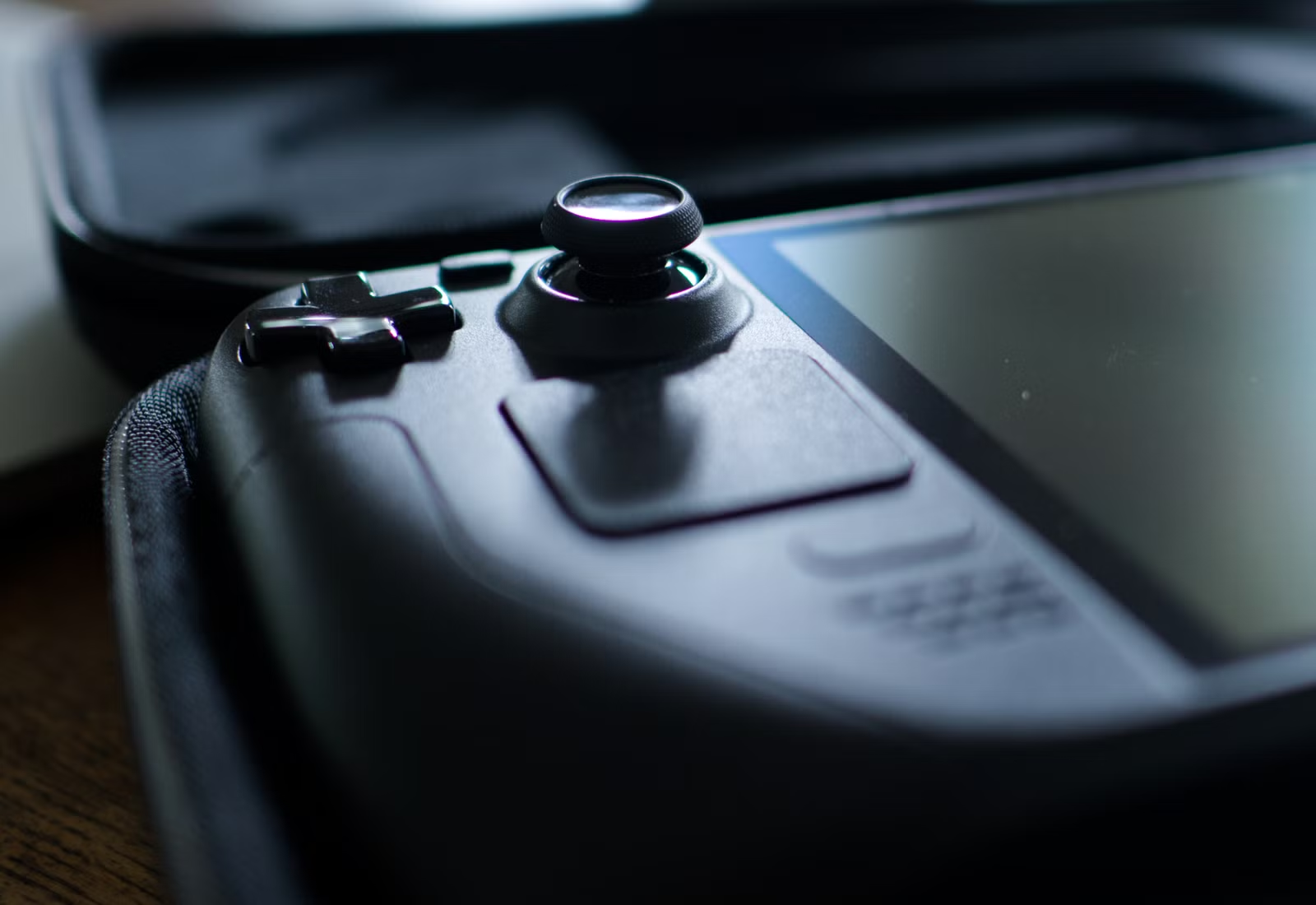
Valve’s Linux-powered handheld has been a huge success. If you haven’t picked up a Steam Deck yet, you may be wondering whether it’s better to buy one now or wait for the next-generation model.
Why I Didn’t Wait for the Steam Deck 2
First, a little context. I’d wanted a Steam Deck ever since Valve launched the handheld in February 2022. When the OLED model followed roughly 18 months later, that interest only grew. The problem was simple: Valve still wouldn’t officially sell me one.
I’m based in Australia, where the Steam Deck didn’t officially arrive until November 2024. Before then, I could have imported one through the grey market, but I wasn’t willing to give up an official warranty or pay an inflated price just to get one early.
So, I waited.
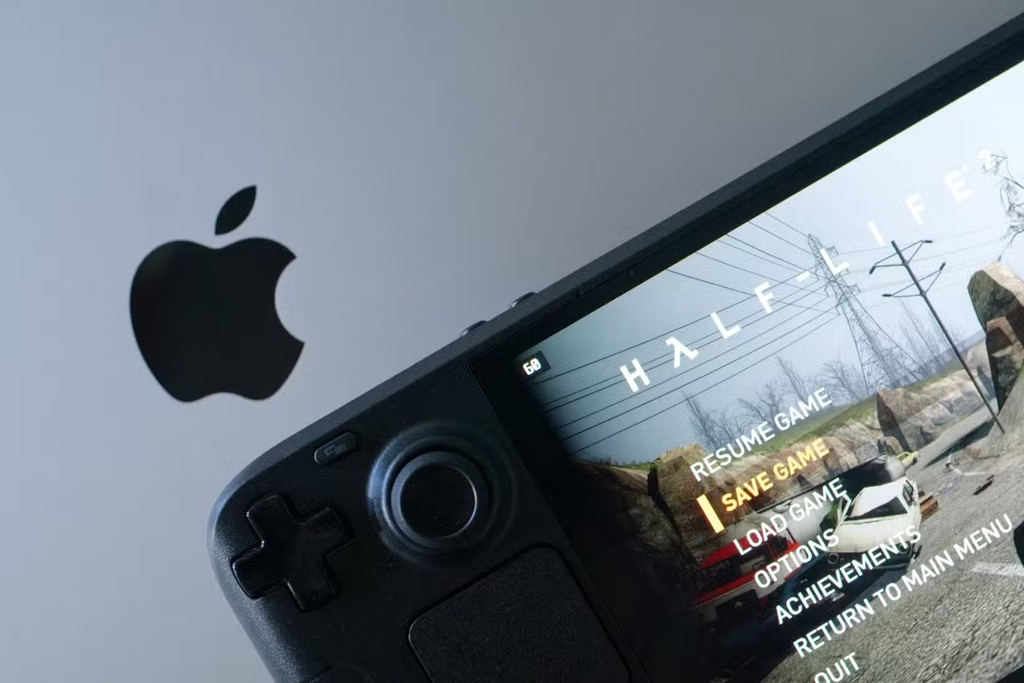
I ordered the 1TB Steam Deck OLED as soon as orders opened, placing mine within the first few minutes. I knew Valve was likely already working on a successor, but that didn’t make me hesitate. Since I don’t own a gaming PC, I wanted a Steam Deck so I could finally start making use of my nearly 20-year-old Steam account again.
More than a month later, I have no regrets about the purchase.
When Should We Expect the Steam Deck 2?
Valve still hasn’t confirmed when a true Steam Deck successor will arrive, but previous comments from the company give us a rough idea of the timeline.
In 2023, Valve product designer Lawrence Yang said that a Steam Deck 2 would need a meaningful “next-generation” performance improvement before the company would consider releasing it. At the time, he suggested the necessary hardware could still be two to three years away.
Based on that estimate, a successor could potentially appear sometime between 2025 and 2026. However, those comments were made well before the hardware landscape became clearer, and Valve may decide to wait even longer if newer chips fail to deliver the kind of efficiency and performance gains it considers worthwhile.
Other gaming companies appear to be taking a similarly cautious approach. In late 2024, Microsoft indicated that its own Xbox handheld was still several years away, suggesting that 2026 could be the earliest realistic window. Sony, meanwhile, isn’t widely expected to introduce the PlayStation 6 until around 2027.
That suggests current-generation hardware may not yet offer a big enough leap to justify entirely new devices. Of course, every company follows a different strategy. Nintendo, for example, has taken a different path with the successor to the Switch, showing that there’s no single timetable the industry is following.
What Might a Steam Deck 2 Look Like?
The biggest upgrade in a Steam Deck 2 will likely be a significant jump in performance. Even the OLED model, which launched in 2023, delivers almost the same gaming performance as the original 2022 Steam Deck. That hardware is starting to show its age, particularly when compared with newer and more powerful handhelds such as the ROG Ally X.

We can expect the Steam Deck 2 to deliver more power across the board. A stronger GPU could bring better upscaling capabilities, while a faster CPU should improve performance in games with demanding simulations and complex systems, an area where the current Steam Deck can struggle in titles such as Baldur’s Gate 3.
Because Valve’s APU uses a shared memory pool for both the CPU and GPU, the next model could also benefit from more RAM running at higher speeds. Faster internal storage would be another welcome upgrade, particularly if Valve increases capacity on the entry-level model. Quicker storage could help reduce bottlenecks when loading textures and other game assets, while additional space would make it easier to manage modern games that continue to grow in size.
Beyond raw performance, Valve could also address some of the current Steam Deck’s display limitations. One notable omission is variable refresh rate, or VRR, support on the built-in screen.
Valve product designer Lawrence Yang has previously said that VRR is high on the company’s list of features it would like to include in future Steam Deck hardware. The feature didn’t make it into the OLED refresh, but it could be a strong candidate for the next-generation model. A display with a refresh rate of 120Hz or higher could also be possible.
Another area Valve could improve is the control hardware. The Steam Deck OLED still uses traditional analog sticks and triggers rather than Hall Effect components. Conventional potentiometer-based sticks can wear down over time and develop drift, while Hall Effect designs use magnetic sensors that are generally more resistant to this problem.
Third-party Hall Effect replacement sticks are already available for the Steam Deck, so it would make sense for Valve to adopt the technology directly in its next handheld.

Finally, longer battery life would be a welcome improvement, although it isn’t guaranteed. The Steam Deck OLED already made noticeable gains in this area, but pushing things further will require Valve to balance efficiency, performance, battery capacity, and the overall size and comfort of the device.
How Much Will a Steam Deck 2 Cost?
Valve had a difficult time hitting the original Steam Deck’s $399 starting price, and Gabe Newell has previously noted that the most expensive version proved to be the most popular. That could influence how the company approaches pricing for a future Steam Deck 2.
This suggests the next-generation model may launch at a higher price than the original. Valve could keep the current Steam Deck around as a more affordable entry-level option while positioning the Steam Deck 2 as a more premium handheld with stronger hardware and a higher price tag.
Competing devices already occupy this higher price range. Handhelds such as the ROG Ally X, MSI Claw A1M, and Lenovo Legion Go typically sell for several hundred dollars more than the base Steam Deck. Valve will likely want to remain competitive, but the final price will depend on the hardware and features it chooses to include.
The Wait Might Not Be Worth It for Everyone
The biggest advantage of a Steam Deck 2 will likely be a substantial increase in performance, which means the people who will benefit most are those who plan to play more demanding games. The types of games you enjoy can make a major difference in whether waiting is worthwhile.
If you mainly want a Steam Deck for games like Slay the Spire, Balatro, or Brotato, the current 2022 or 2023 models are already more than capable. The same applies if you mostly play indie titles or turn-based RPGs such as Persona and Sea of Stars. For those kinds of games, the existing Steam Deck still offers plenty of performance.

The same applies if you’re mainly interested in older games such as Batman: Arkham Origins and Middle-earth: Shadow of Mordor. Both can run at around 60 FPS on the Steam Deck, while more demanding titles like Elden Ring and God of War: Ragnarok generally sit closer to 40 FPS, depending on your settings.
If you see the Steam Deck primarily as an emulation device, the current model may already be enough. Extra performance would certainly help with more demanding systems such as the PlayStation 3, but the Steam Deck OLED is already far more capable than many dedicated retro handhelds, even if it comes at a much higher price.
The same is true if you mostly plan to stream games from a gaming PC, Xbox, or PlayStation 5. Since the Steam Deck isn’t doing the heavy lifting in those cases, upgrading your PC or improving your home network could be a better use of your money than waiting for more powerful handheld hardware.

Lastly, if you are limited by your budget, the Steam Deck 2 is almost certainly going to cost more than the current offering.
Love Your Triple-A Games? You Might Want to Wait
If you want the Steam Deck to serve as your main gaming PC for the latest triple-A releases, waiting for the Steam Deck 2 may make more sense. By early 2025, the current hardware was already beginning to struggle with some newer and more demanding games.
Titles such as Indiana Jones and the Great Circle and Path of Exile 2 can push the Steam Deck beyond its comfortable limits, resulting in weaker performance and more compromises. In that case, waiting for a next-generation model or considering a more powerful handheld PC could be the better option.
Should You Wait for the Steam Deck 2? I Didn’t — FAQs
Should I wait for the Steam Deck 2?
It depends on what you want to play. If you mainly enjoy indie games, older titles, emulation, or game streaming, the current Steam Deck is still a strong option. Players focused on demanding new AAA games may benefit more from waiting for newer hardware.
When will the Steam Deck 2 be released?
Valve has not announced an official release date for the Steam Deck 2. The company has indicated that it wants a meaningful improvement in performance and efficiency before launching a true successor.
Is the Steam Deck OLED still worth buying?
Yes, especially if you value its OLED display, improved battery life, quieter operation, and access to a large Steam library. Its performance is similar to the original Steam Deck, but the overall experience is more refined.
Will the Steam Deck 2 be much more powerful?
A significant performance improvement is likely to be one of the main reasons for releasing a new generation. A faster CPU, stronger GPU, improved memory, and newer upscaling technologies could all help future hardware handle more demanding games.
Will the Steam Deck 2 cost more than the current model?
It could. More powerful hardware and premium features may push the price higher than the original Steam Deck, although Valve will likely want to keep the device competitive with other handheld gaming PCs.
Can the current Steam Deck handle AAA games?
It can run many AAA titles, but newer and more demanding releases may require lower graphics settings, reduced frame rates, or other compromises. Future games are also likely to become increasingly difficult for the current hardware to handle.
Who should buy a Steam Deck now instead of waiting?
The current Steam Deck makes the most sense for players who want to enjoy indie games, older PC titles, turn-based RPGs, emulation, and game streaming. If those are your priorities, waiting for the Steam Deck 2 may not provide enough benefit to justify delaying your purchase.
Conclusion
Waiting for the Steam Deck 2 could make sense if you mainly want better performance for future AAA games and don’t mind holding off for newer hardware. However, the current Steam Deck, especially the OLED model, is still a great choice for indie games, older PC titles, RPGs, emulation, and game streaming.
For me, waiting wasn’t necessary. I wanted a portable way to enjoy my Steam library now, and the Steam Deck OLED already gives me that experience. A newer model will eventually arrive, but that doesn’t make the current Steam Deck any less enjoyable today.
